

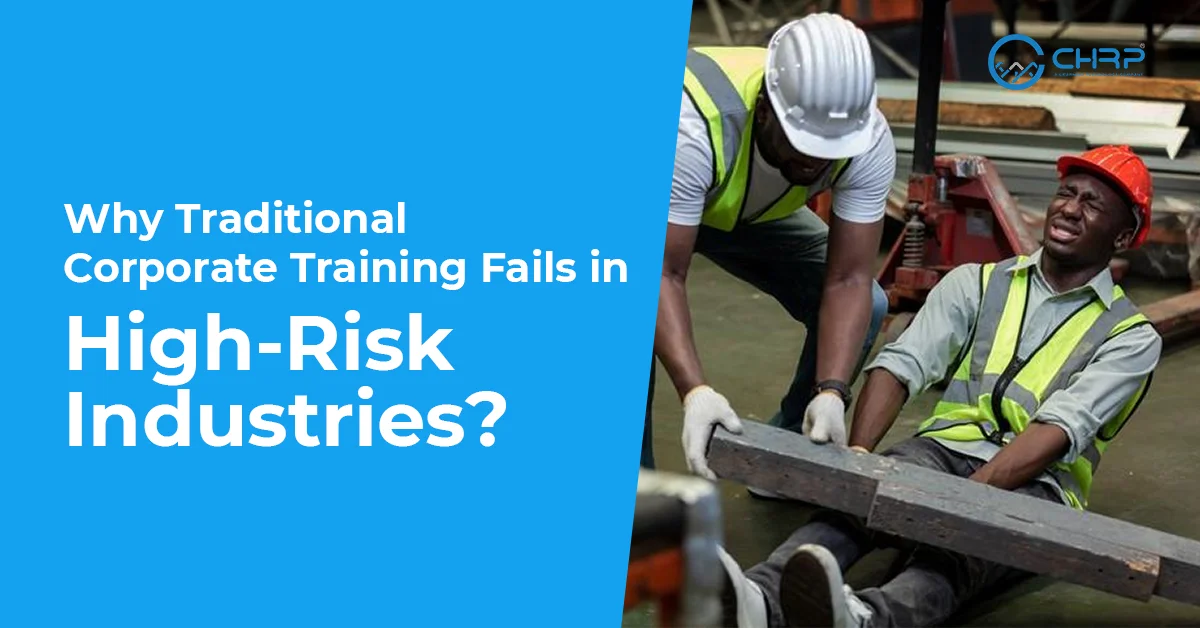
In high-risk industries such as oil, gas, construction, mining & manufacturing or aviation, and even healthcare, training is not a support function; it is a risk control. Yet many organisations continue to rely on traditional corporate training models that were never designed for environments where a single mistake can be fatal, cause environmental damage, regulatory violations, or loss of life.
For Learning & Development (L&D) managers and business decision makers, this creates a dangerous disconnect: employees may be trained according to compliance standards, but not truly prepared for real-world conditions. Understanding why traditional corporate training fails in high-risk industries is essential for improving safety performance, operational reliability, and workforce readiness.
The Reality of Training in High-Risk Industries
High-risk environments are defined by uncertainty, time, pressure, complex systems, and human factors. Workers are expected to make fast, accurate decisions-often under stress-while following strict safety and operational procedures.
Traditional training methods, however, were largely built for low-risk, knowledge-based roles. Classroom lectures, slide-based e-learning, and annual courses struggle to prepare employees for dynamic, hazardous situations. The result is training that meets regulatory requirements but falls short in practice.
- Traditional Training Measures Completion, Not Capability
Most corporate training programs are evaluated using surface-level metrics such as course completion, attendance, or multiple-choice test scores. While these metrics are easy to report, they do not indicate whether an employee is ready to perform critical tasks safely on the job.
In high-risk industries, competence matters more than knowledge. An employee may pass a written assessment yet fail to apply procedures correctly during an emergency or abnormal situation. Traditional training models rarely assess real-world performance, leaving organizations blind to actual readiness levels.
- Passive Learning Does Not Hold Up Under Pressure
Lectures, presentations, and normal online modules rely on passive learning. While these approaches can transfer information, they do little to build decision-making skills or behavioural consistency.
When people operate under stress, they are used to ingrained habits, not remembered slides. Without active practice, repetition, and feedback, training content is quickly forgotten. In high-risk work environments, this gap between knowledge and behaviour is where incidents occur.
- Generic Training Ignores Site-Specific and Role-Specific Risks
One-size-fits-all training programs are attractive from a cost and scalability perspective, but they are poorly suited for high-risk operations. Risks vary significantly by role, site, equipment, and operating conditions.
When training content feels generic or disconnected from daily tasks, engagement drops. Employees may comply with training requirements, but they do not internalise the learning. Over time, training becomes a box-ticking exercise rather than a meaningful performance tool.
- Infrequent Training Fails to Build Muscle Memory
Many organisations rely on annual or every 6 months training cycles. In high-risk industries, this frequency is insufficient for building and maintaining critical skills.
Tasks such as emergency response, hazard recognition, lockout/tagout, confined space entry, or equipment operation require regular practice. Without continuous reinforcement, skills degrade rapidly. Traditional training assumes learning is permanent, but neuroscience and operational data show that skills fade without ongoing application.
- Traditional Training Lacks Realistic Context
High-risk work environments are unpredictable. Noise, fatigue, time pressure like need of taking immediate decisions, and environmental hazards all influence performance.
Without exposure to realistic scenarios, decision-making under pressure, and consequence-based learning, training does not prepare workers for the realities they face.
- Limited Feedback and Poor Visibility Performance Gaps
Traditional corporate training often ends with a quiz or sign-off, providing minimal insight into individual or team-level risk exposure. L&D teams and leaders are left without meaningful data on who needs additional support or practice.
In high-risk industries, this lack of visibility is a serious weakness. Organisations need performance-based insights-not just completion records-to proactively reduce incidents and improve safety outcomes.
What Effective Training Looks Like in High-Risk Industries?
Modern learning strategies for high-risk environments focus on performance. Effective programs typically include:
- Scenario-based and experiential learning
- Role-specific and site-specific content
- Frequent, short learning interventions
- Realistic simulations and practical assessments
- Continuous feedback and performance data
- Integration with safety and operational goals
These approaches align training with how people actually learn and perform under pressure.
A Strategic Imperative for L&D Leaders
For L&D managers and decision makers, moving beyond traditional corporate training is no longer optional. In high-risk industries, ineffective training increases exposure to incidents, downtime, legal risk, and reputational damage.
The goal is not more training, but better, more impactful training. Training that reflects real-world conditions, builds behavioural competence, and provides clear insight into workforce readiness.
When learning is designed around performance and risk, it becomes a strategic asset-one that protects people, strengthens operations, and supports long-term business resilience.
So, are you ready to train your employees in risk-free virtual environments? Contact CHRP-INDIA.
CHRP-INDIA is a custom eLearning and XR immersive training development company for both corporate and the Industry workforce, helping in training the employees for better future performance and reducing accidents in workplaces.